Why I warm up and stretch around every resistance session
A practical look at the warm up and stretching I build around resistance training, why each part matters, and how to fit both into a busy week without losing training time.

On this page
Most people who come to me in Krakow are short on time. They want to get under the bar quickly and leave. Warm ups and stretching feel like the first thing to cut. I understand that, and I still ask them to keep both. So I keep them in the plan, and here is what each part does for you.
Warm up and stretching are two different jobs
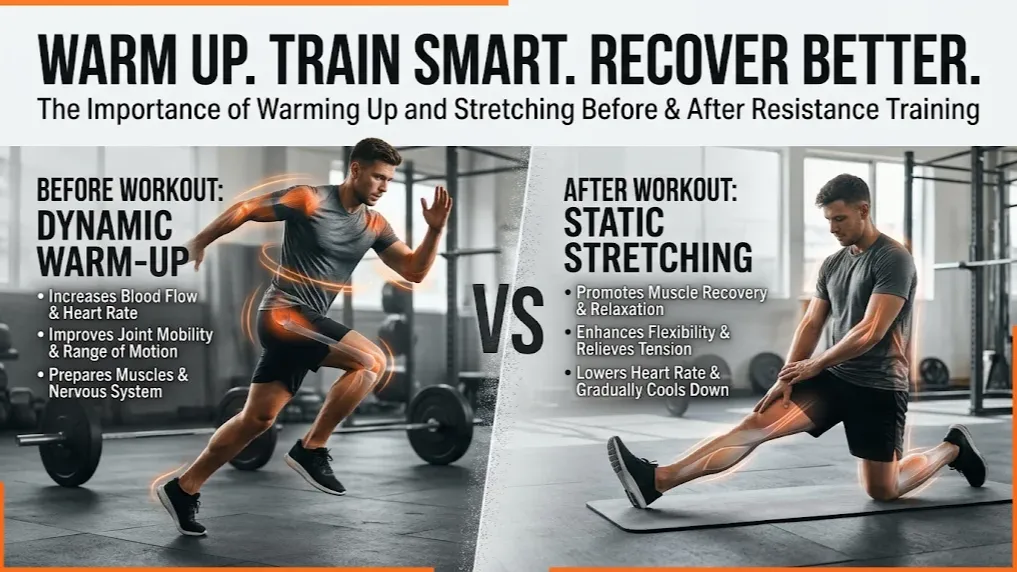
People use the words as if they mean the same thing. They do not. A warm up raises your body temperature and gets your joints and nervous system ready for load. Stretching works on range of motion and how the tissue feels. One prepares you to lift. The other keeps your movement comfortable over the long run.
If you only have ten minutes before training, spend them on the warm up. Save the longer stretches for after the session or for a separate day.
What my warm up looks like before a resistance session
The shape stays the same whatever we train. General movement first, then something specific to the lifts of the day, then ramp up sets with the bar or a light dumbbell.
A simple sequence I use
Three to five minutes of easy movement. A brisk walk, a stationary bike, or a few rounds of step ups.
Joint circles and controlled rotations for shoulders, hips, spine and ankles. Slow, no bouncing.
Two or three light sets of the first main lift, adding weight each time until you reach your working set.
That last part matters more than any stretch. A squat with 60 kg feels different from a squat with an empty bar. Give the body a chance to meet the load step by step and the first heavy set will look much better.
Injury risk, told honestly
I cannot promise that a warm up will keep you injury free. Nobody can. What I can say is that cold tissue, stiff joints and a heavy bar on the first set is a combination I see go wrong. Most of those problems show up in the first working set, not in the fifth.
Stretching on its own has a mixed record for injury prevention. Static stretching held for a long time right before heavy lifting can even leave you feeling weaker for a few minutes. That is why I keep long holds out of the pre workout window and put them at the end.
Warm up to lift well. Stretch to move well the rest of the day.
The cool down and why I do not skip it
After the last set I ask for five minutes of easy movement and a few relaxed stretches for the muscles we just worked. Nothing heroic. A walk around the gym, some breathing that slows down, then thirty to sixty seconds per position on the areas that feel tight.
What I stretch after training
Chest and front of the shoulder after pressing.
Hips and glutes after squats and deadlifts.
Lats after any pulling work.
Calves and ankles if the session had a lot of loading through the legs.
Keep the holds comfortable. If you are holding your breath, you are pushing too hard.
Recovery you notice the next day
Light movement and gentle stretching after training help you feel less stiff in the following days. They do not erase soreness, and they are not a substitute for sleep or food. But clients who do the short cool down routine tend to walk into the next session moving better and complaining less about tightness.
Recovery is mostly built from the boring things. Enough protein, enough sleep, and a training plan that matches what your body can handle. Stretching and easy movement are a small but useful part of that picture.
Does stretching help muscle growth
Not directly. Muscle grows from progressive resistance training and enough food. What stretching can do is keep your joints moving through a full range, so you can train the whole length of a muscle with load. A deep squat or a full stretch at the bottom of a press needs mobility. Give the tissue that range outside the gym and the lifts inside it get easier to perform well.
I also use stretching to check in with clients. Tightness on one side often tells me something about how they sit, stand or carry loads during the week.
How to fit this into a busy week
Ten minutes before, five minutes after. That is enough for most people. If your calendar is tight, warm up with the first two exercises instead of doing separate cardio, and stretch at home in the evening while you watch something.
If you have a current injury, a history of joint problems or pain that comes and goes, talk to a doctor or a physiotherapist before you add long stretches to your routine. Then bring that advice to me and we will build it into your plan.
Tags: Calorie Tracker, Nutrition, Diet